
Lateral vs. Vertical Bulk Filing Cabinets & Mobile Pedestals: B2B Space Planning & Coordinating with Wholesale Office Desks

In commercial corporate fit-outs, government facilities, and professional service offices, document storage is often treated as an afterthought—procured in haste after executive desks and open-plan workstations have already consumed the floor plate. Yet, inefficiently planned filing systems are among the primary causes of circulation choke points, code compliance violations, and visual clutter in modern workspaces.
Selecting between lateral filing units, traditional vertical cabinets, and mobile pedestals is not merely a question of aesthetic preference; it is a mathematical calculation of square footage cost, filing capacity, and workflow ergonomics. In high-cost US metropolitan commercial leases, every square foot dedicated to storage must be maximized.
As part of our specialized contract furniture series at MMK Furniture Makers (MMK TRADE INC), this guide breaks down the engineering, spatial footprints, and design synergies required to plan high-density custom office storage B2B solutions while maintaining complete visual harmony with your commercial office furniture.
1. Commercial Storage Typologies: Lateral vs. Vertical vs. Mobile Pedestals
Understanding the geometric and operational differences between storage silhouettes allows commercial designers to deploy the right SKU to the right corporate department:
1.1 Lateral Filing Cabinets: The High-Capacity Dual-Purpose Unit
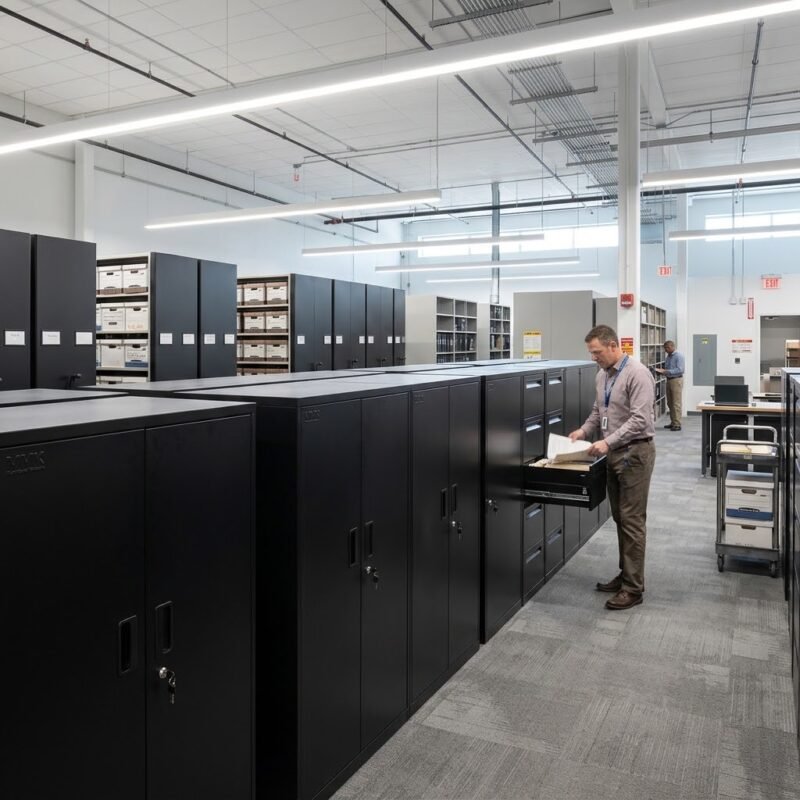
Lateral cabinets are wide (typically 30, 36, or 42 inches wide) and shallow (18 to 20 inches deep). Files are arranged side-by-side parallel to the cabinet face or front-to-back using conversion hanging rails.
- Best Commercial Use: Departmental copy rooms, perimeter corridor walls, and open-plan team separators. Two-drawer lateral units (28 inches high) match standard desk heights, enabling specifiers to extend worksurface runs seamlessly.
- Filing Flexibility: Accommodates both US Letter-size and Legal-size records within the same drawer by adjusting interior hanging crossbars.
1.2 Vertical Filing Cabinets: Deep-Reach Archive Units
Vertical cabinets are narrow (15 to 18 inches wide) but deep (25 to 28 inches deep). Folders are stored front-to-back in a single row per drawer.
- Best Commercial Use: Back-office records rooms, legal archiving closets, and executive offices where linear wall space is at a premium.
- Space Trade-Off: While they consume minimal wall width, vertical drawers extend nearly 27 inches into the room when opened, requiring substantial front aisle clearances.
1.3 Mobile Pedestals: The Personal Hub for Agile Workstations
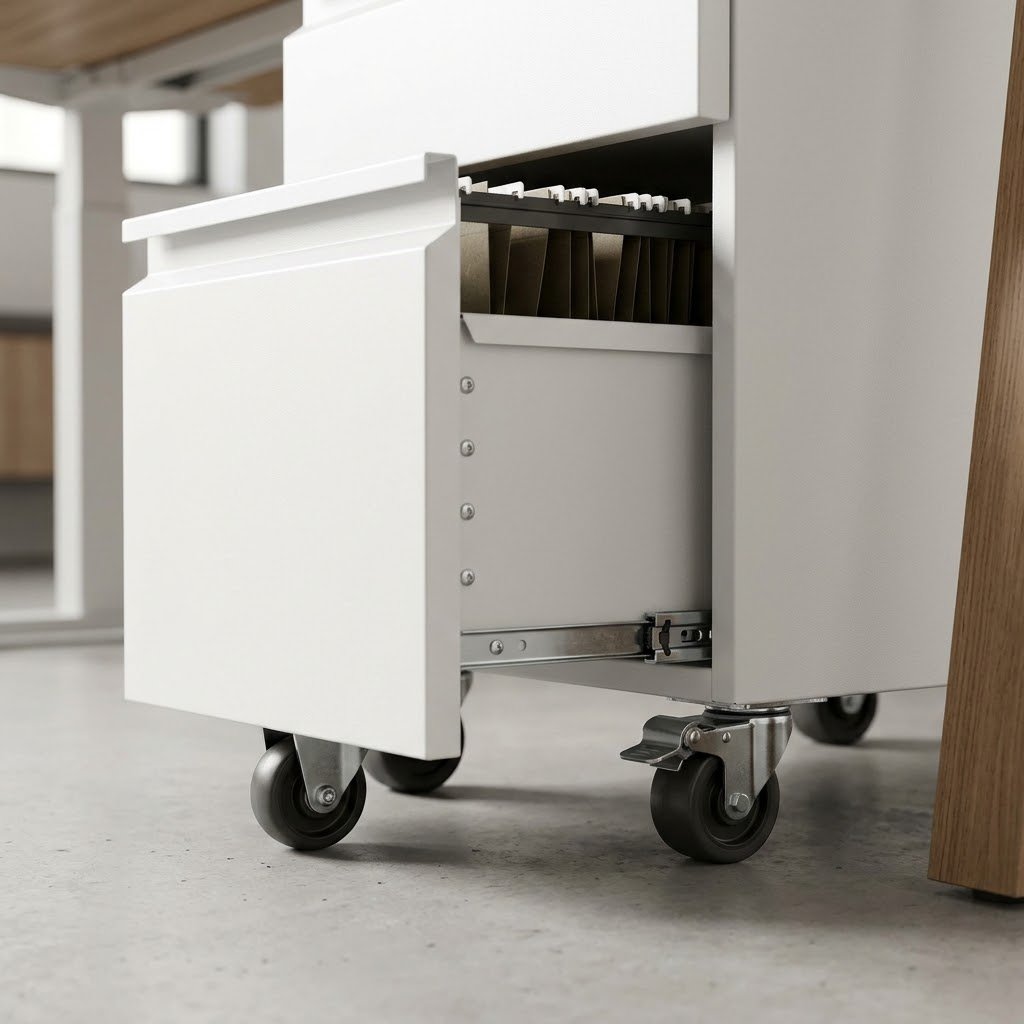
Mobile pedestals (typically 15 inches wide, 20 inches deep, and 22 to 24 inches high) are designed to roll effortlessly under standard commercial workstation desks.
- Best Commercial Use: Unassigned hoteling desks, agile benching workstations, and modern hybrid offices where employees store personal items and daily active files.
- Configuration: Typically configured as Box/Box/File (two utility drawers plus one filing drawer) or File/File.
2. Technical Comparison Matrix: Capacity, ADA Clearances & Letter/Legal Ratios
To assist corporate facilities buyers and architects in evaluating space allocations, the table below provides engineering dimensions, linear file capacities, and accessibility metrics across commercial filing categories:
| Storage Category | Standard Dimensions (W x D x H) | Linear Filing Capacity (Inches/Drawer) | Drawer Extension Depth | Min. Total Aisle Required (ADA 36″ Clear) | Filing Orientation |
|---|---|---|---|---|---|
| Lateral Filing Cabinet (36″ 4-Drawer) | 36″W x 18″D x 53″H | ~32.5 linear inches | 18 inches | 54 inches (18″ drawer + 36″ clear) | Letter & Legal (Side-by-side or front-to-back) |
| Lateral Filing Cabinet (42″ 4-Drawer) | 42″W x 18″D x 53″H | ~38.5 linear inches | 18 inches | 54 inches (18″ drawer + 36″ clear) | High-density dual-row Legal / Letter |
| Vertical Filing Cabinet (4-Drawer Letter) | 15″W x 26.5″D x 52″H | ~25.0 linear inches | 25 inches | 61 inches (25″ drawer + 36″ clear) | Letter only (Front-to-back single row) |
| Vertical Filing Cabinet (4-Drawer Legal) | 18″W x 26.5″D x 52″H | ~25.0 linear inches | 25 inches | 61 inches (25″ drawer + 36″ clear) | Legal only (Front-to-back single row) |
| Mobile Filing Pedestal (Box/Box/File) | 15″W x 20″D x 23″H | ~18.0 linear inches | 18 inches | Under-Desk (Zero dedicated aisle loss) | Letter or Legal convertible |
3. B2B Space Planning: Drawer Travel, Aisle Widths & Acoustic Partitioning
When laying out large-scale wholesale office furniture projects, the most critical spatial error is failing to calculate total drawer travel. A 4-drawer vertical cabinet looks compact on a 2D floor plan because its width is only 15 inches. However, in execution, opening a 25-inch deep drawer into a standard 42-inch office hallway leaves only 17 inches of clearance—violating US fire codes and creating severe tripping hazards.
3.1 The 36-Inch ADA Corridor Rule
Under the Americans with Disabilities Act (ADA) Accessible Guidelines (Section 403), all primary accessible circulation corridors must maintain a minimum clear width of 36 inches continuously. For office storage corridors:
- Lateral File Aisle Formula: Depth of Cabinet (18″) + Full Drawer Extension (18″) + Mandatory ADA Clearance (36″) = 72 inches (6 feet) total recommended corridor width if employees must walk past an open drawer. For secondary or dead-end record alcoves, a minimum of 54 inches is acceptable.
- Vertical File Corridor Pitfall: With a 25-inch drawer extension, maintaining a 36-inch clear walking lane requires a 61-inch minimum corridor width. If two banks of vertical cabinets face each other, the corridor must be at least 86 inches wide to permit simultaneous egress.
3.2 Active Acoustic Zoning with Low-Profile Lateral Units
Commercial open-plan workspaces suffer from acoustic distractions and lack of physical definition. Instead of purchasing expensive, immovable drywall partitions or fabric cubicle screens, forward-thinking interior designers specify 2-drawer or 3-drawer lateral wholesale storage cabinets equipped with acoustic laminate back panels or integrated top planter troughs.
This strategy achieves three goals in a single furniture investment: provides high-density team filing, dampens ambient speech travel, and maintains open ceiling sightlines without blocking natural daylight from exterior windows.
4. Coordinating Storage with Wholesale Office Desks & Workstations

Fragmenting your FF&E specification—sourcing metal filing cabinets from one supplier, laminate desks from another, and mobile pedestals from a third—almost always results in mismatched paint sheen, conflicting edge-banding radii, and varied lock-keying chaos.
As a vertically integrated contract manufacturer, MMK Furniture Makers enables commercial dealers and corporate specifiers to unify their entire floor plan under a cohesive material palette:
4.1 Dimensional Alignment Rules
- The 28.5″ Height Alignment: Standard commercial desk worksurfaces sit at 28.5 to 29 inches high. When ordering our 2-drawer lateral file credenzas, we match this exact height profile. This allows facility planners to position lateral files flush against executive desks or L-shaped workstation returns, effectively creating an extended continuous L- or U-shaped work surface without hazardous lip gaps.
- Mobile Pedestal Knee-Clearance: To ensure ergonomic comfort under standard 60″x30″ or 72″x36″ desks, mobile pedestals should never exceed 15 inches in width and 24 inches in height. This preserves the mandatory 30-inch minimum knee clearance width required by ANSI/BIFMA ergonomic standards for the user’s task chair.
4.2 Unified Finish Integration (Steel RAL Colors & HPL Woods)
We synchronize our electrostatic thermoset powder-coat finishes across metal desk legs, file cabinet wrappers, and task lighting fixtures. Whether specifying Architectural Matte Black (RAL 9005), Gunmetal Gray (RAL 7016), or Pure Signal White (RAL 9003), your metal casegoods will share identical texture and gloss levels. Similarly, our commercial HPL laminate tops match perfectly across desks, filing credenza caps, and conference room tables.
5. OEM Customization Capabilities: Interlocks, Finishes & Master-Key Systems
Enterprise procurement groups and commercial contract dealers require more than basic off-the-shelf catalog models. At MMK TRADE INC, we provide full OEM and ODM engineering flexibility across all storage orders:
Anti-Tip Interlock Safety
Every multi-drawer lateral and vertical file is engineered with an internal mechanical single-drawer interlock bar. When one drawer is pulled open, the locking cam instantly blocks the remaining drawers from releasing, eliminating accidental tip-over accidents without relying solely on wall anchors.
Interchangeable Core Locks
We supply commercial-grade core-removable cam locks. Facility managers can re-key an entire floor plan within seconds using a single control key, or implement grand master key systems where managers access all units while individual users possess unique keys.
Knock-Down (KD) Container Logistics
To overcome the prohibitive cost of “shipping air” across international ocean routes, MMK engineers high-precision snap-fit Knock-Down (KD) steel cabinets that assemble on-site in under 8 minutes without exposed screw heads, tripling your 40HQ container capacity.
6. Space Planning & Sourcing FAQ
Q1: How do I calculate whether a corporate department needs Lateral or Vertical filing cabinets?
Q2: Can mobile pedestals safely support the weight of an employee sitting on them during quick desk huddles?
Q3: How do we prevent mobile pedestals from rolling away on hard concrete or hardwood floors?
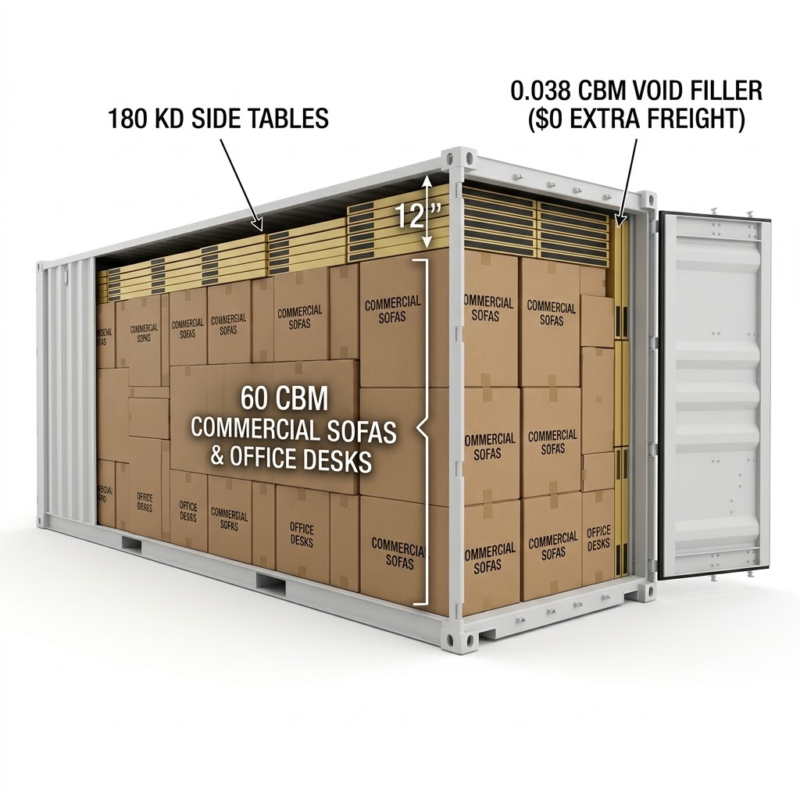
Q4: Can we consolidate bulk filing cabinets with office desks and task lamps in a single ocean container?
Plan Your Commercial Office Storage with Factory-Direct Precision
Partner directly with MMK TRADE INC for contract-grade filing cabinets, custom office desks, and cohesive commercial interiors.