
CAL 117-2013, NFPA 260 & CPSC Flammability Compliance: The US Importer’s Guide to Commercial Upholstered Sofas

⚡ Quick Takeaway for US Furniture Importers & FF&E Buyers
- The National Mandate: The US CPSC has formally adopted California TB 117-2013 as the mandatory federal flammability standard for all upholstered furniture (codified under 16 CFR Part 1634). Non-compliant containers will be detained by US Customs.
- Commercial Code (NFPA 260): While CAL 117 is the baseline, commercial spaces (hotel lobbies, restaurants, offices) typically require NFPA 260 commercial couches featuring Class 1 smolder-resistant cover fabrics to pass local fire marshal inspections.
- The Chemical Ban: Fire safety can no longer rely on toxic chemical sprays. True compliance requires PFAS/PBDE-free inherently fire-resistant foams and specialized barrier cloths.
- Mandatory Law Labels: Sourcing from a verified CAL 117 compliant sofa manufacturer guarantees that your seating ships with legally required Uniform Law Labels and valid URNs (Uniform Registry Numbers) sewn directly into the furniture.
Introduction: The High-Stakes World of Upholstery Compliance
When a B2B procurement team imports casegoods (like wooden desks or tables), their primary concerns are usually aesthetics and physical durability. However, the moment a piece of furniture includes foam padding and fabric—such as wholesale sofas or commercial dining chairs—it enters a highly regulated, legally perilous category of US import law.
Upholstered furniture contains polyurethane foam, which is highly combustible. To prevent catastrophic indoor fires, the United States has enacted strict, mandatory flammability regulations. Sourcing from an overseas factory that does not deeply understand the nuances of the US Consumer Product Safety Commission (CPSC) guidelines is a massive liability. Non-compliant containers are routinely seized by US Customs and Border Protection (CBP), and commercial building inspectors will force the removal of non-compliant seating from hotel lobbies and restaurants prior to occupancy.
As a dedicated CAL 117 compliant sofa manufacturer, MMK Furniture Makers (operated by MMK TRADE INC) has engineered our entire supply chain to meet and exceed North American fire safety laws. This guide unpacks the critical technical standards you must verify before signing a commercial upholstery PO.
- For a broader view of OEM sofa engineering, including BIFMA structural frames and foam densities, read our master pillar page: The Complete B2B Sourcing Guide to Wholesale Sofas.
- To learn about the mandatory US safety laws regarding cabinet tip-overs, read our guide on: ASTM F2057 Anti-Tip Safety Compliance for Storage Casegoods.
1. 16 CFR Part 1634: How CAL 117-2013 Became Federal Law
For years, California Technical Bulletin 117-2013 (TB 117-2013) was technically only a state law. However, because California represents such a massive portion of the US economy, the furniture industry adopted it as a de facto national standard.
Recently, this changed from a voluntary best practice into a mandatory federal law. The US Congress passed the Safer Occupancy Furniture Flammability Act (SOFFA), directing the CPSC to officially adopt CAL 117-2013 as the national flammability standard for upholstered furniture (codified as 16 CFR Part 1634).
The Smolder Resistance Test
The outdated 1975 version of CAL 117 required foam to withstand a 12-second open flame (which forced manufacturers to douse foam in toxic chemicals). The updated CAL 117-2013 standard focuses instead on smolder resistance, simulating the most common cause of furniture fires: a dropped, smoldering cigarette.
To pass, the sofa manufacturer must submit three specific components for independent laboratory testing:
- Cover Fabrics: The exterior upholstery fabric must not ignite into open flames when exposed to a smoldering heat source for 45 minutes.
- Barrier Materials: If the cover fabric fails the test, a fire-blocking barrier cloth must be placed beneath the fabric to protect the foam.
- Resilient Filling Materials (Foam): The internal polyurethane foam must demonstrate inherent smolder resistance without accelerating combustion.
2. NFPA 260: The Commercial and Hospitality Standard
While CAL 117-2013 is the federal baseline for all upholstered furniture, commercial environments—such as hotel lobbies, airports, restaurants, and executive offices—are subject to stricter oversight by local fire marshals.
When sourcing commercial lounge seating, architects and interior designers frequently specify NFPA 260 (National Fire Protection Association) compliance. This standard specifically evaluates the cigarette ignition resistance of components used in public occupancy buildings.
Class 1 Cover Fabrics
Under NFPA 260, upholstery fabrics are classified based on their performance. MMK TRADE INC exclusively sources and utilizes Class 1 Cover Fabrics for our NFPA 260 commercial couches. Class 1 fabrics demonstrate the highest level of smolder resistance (char length must not exceed 1.75 inches). By integrating Class 1 fabrics with our inherently fire-resistant high-density foams, we guarantee that your hospitality FF&E package will pass local fire marshal inspections with ease.
3. The Chemical Shift: Eliminating PFAS and PBDEs

In the past, the easiest way for a factory to pass fire tests was to saturate the polyurethane foam and upholstery fabric in chemical flame retardants, particularly PBDEs (Polybrominated diphenyl ethers). However, these chemicals have been linked to severe health issues, cancer, and environmental toxicity.
Today, US legislation—including California Proposition 65 and various state-level bans—strictly prohibits or requires aggressive warning labels for furniture containing these toxic chemicals. Furthermore, several states have banned PFAS (Per- and polyfluoroalkyl substances), often called “forever chemicals,” which were historically used for stain-proofing.
The MMK Engineering Solution
As a responsible manufacturer of US fire retardant upholstered furniture wholesale, MMK TRADE INC achieves CAL 117 compliance via physics and material science, not toxic chemistry:
- FR-Free High-Resiliency Foams: Our foam suppliers utilize advanced polyurethane cellular structures that inherently resist smoldering without the addition of halogenated flame retardants.
- Barrier Cloth Interliners: If a client requests a highly natural, combustible fabric (like pure untreated cotton or linen), we wrap the internal foam core in a specialized, non-toxic fire-blocking barrier cloth. This interliner stops a smoldering fabric fire from ever reaching the foam core, ensuring full compliance while keeping the product chemically safe.
4. US Customs Clearance: Uniform Law Labels & URNs
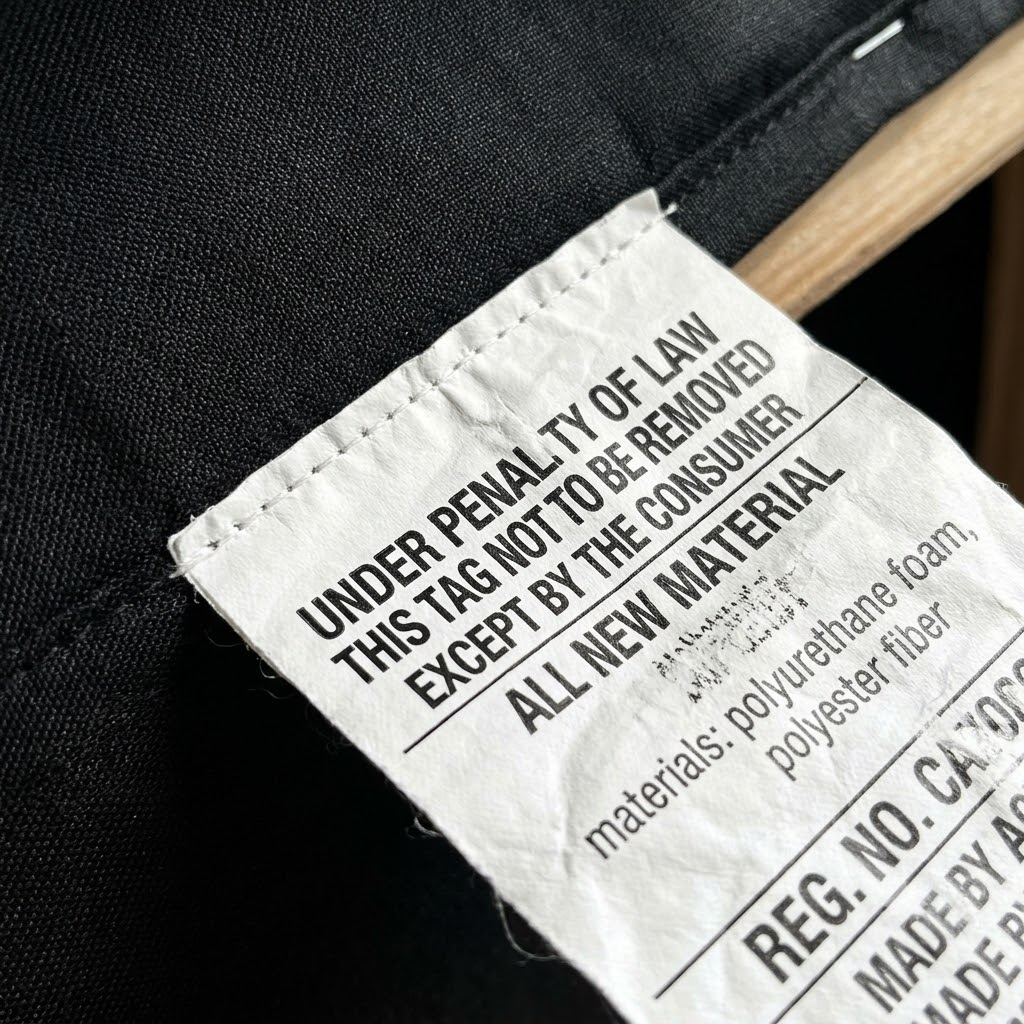
Even if a sofa passes laboratory fire tests, a single missing piece of paperwork can result in your container being held at a US port. Administrative compliance is enforced via the Uniform Law Label.
The Anatomy of a Law Label
Every single commercial sofa exported by MMK features a permanent white tag sewn securely into the bottom decking. This label contains:
- The mandatory header: “UNDER PENALTY OF LAW THIS TAG NOT TO BE REMOVED EXCEPT BY THE CONSUMER”.
- A precise breakdown of the concealed filling materials by percentage (e.g., 90% Polyurethane Foam, 10% Polyester Fiber).
- The factory’s Uniform Registry Number (URN), which tracks the exact manufacturing facility across all 50 states.
- The required CPSC Flammability Statement confirming compliance with the smolder resistance requirements of 16 CFR Part 1634 (CAL 117-2013).
- A distinct checkbox indicating whether the upholstery materials contain added flame retardant chemicals (ours are marked “Contain NO added flame retardant chemicals”).
5. Cross-Category Safety: Dining Chairs & Casegoods Compliance
When executing a large-scale commercial FF&E project, flammability regulations do not stop at the living room. Any seating element containing foam is heavily scrutinized by US Customs.
If you are sourcing commercial dining chairs or bar stools alongside your lounge seating, they must also feature CAL 117-2013 compliant foams, Class 1 fabrics, and stitched Law Labels.
Furthermore, if your living room furniture order includes media consoles or storage cabinets, those items trigger an entirely different set of CPSC regulations regarding tip-over hazards. As a holistic B2B supplier, MMK TRADE INC manages all cross-category compliance under one roof. Our upholstered goods are certified fire-safe, and our casegoods are engineered with rear counterweights and interlocking drawer glides to comply perfectly with the mandatory ASTM F2057 STURDY Act regulations.
6. B2B Fire Retardant Compliance FAQ
Do you provide test certificates for Amazon, Wayfair, and US Customs?
Is CAL 117-2013 required for outdoor patio furniture?
Do you handle the Uniform Registry Number (URN) registration?
Secure Your Supply Chain with Compliant Seating
Partner directly with MMK TRADE INC for CAL 117 & NFPA 260 certified, chemical-free commercial upholstery and turnkey US DDP logistics.