

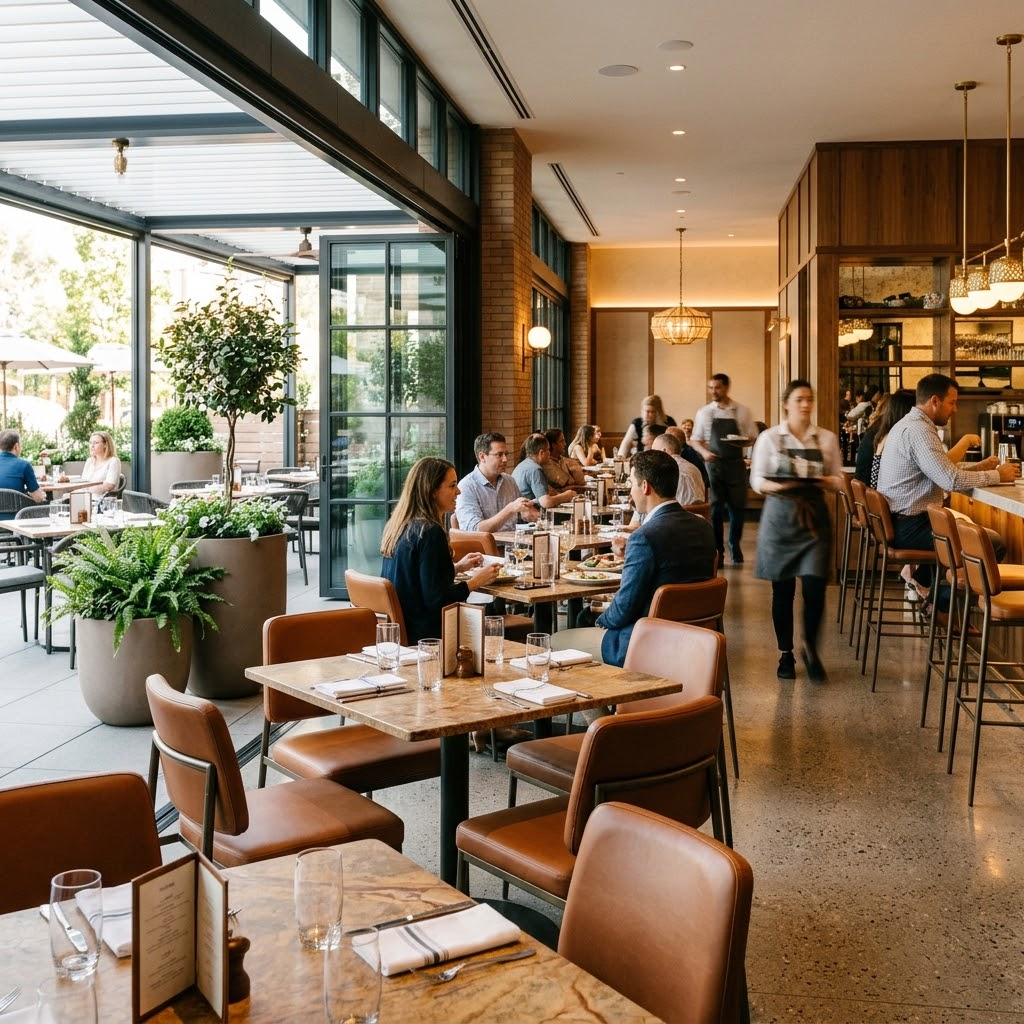
How to Source Wholesale Dining Tables and Chairs for Restaurants, Cafes, and Hospitality Projects

Quick Takeaway for Hospitality Buyers
- Target Application: Engineered specifically for US full-service restaurants, fast-casual franchises, boutique cafes, hotel dining rooms, and catering venues.
- Space & Revenue Optimization: Standardized commercial footprints (
24"x24",30"x30",30"x48") maximize RevPASH (Revenue Per Available Seat Hour) while maintaining mandatory 36-inch ADA and fire-egress corridors.- High-Turnover Durability: Features heavy-duty cast-iron pedestal bases, 2K catalyzed polyurethane and HPL stain-proof surfaces, and bleach-cleanable (1:10 ratio) commercial upholstery rated at 50,000+ Wyzenbeek double rubs.
- Factory-Direct Fulfillment: MMK Furniture Makers (MMK TRADE INC) offers consolidated 40HQ container mixing across indoor dining, bar seating, and patio furniture with turnkey US DDP (Delivered Duty Paid) delivery.
Introduction: Why Hospitality Seating Procurement Dictates Restaurant Profitability
In the United States hospitality sector, dining room furniture is far more than an interior design expense—it is a primary revenue-generating asset. Every square foot of a restaurant, cafe, or hotel dining room floor plan must work tirelessly to balance two competing priorities: guest dwell-time comfort and table-turnover efficiency.
When restaurant owners, franchise procurement managers, or hospitality contractors make the mistake of sourcing retail or residential-grade furniture for a commercial build-out, the operational fallout is immediate. Lightweight table bases rock unevenly on tiled floors, forcing servers to wedge folded coasters under table legs. Unsealed wood veneers blister and peel after three months of wiping with quaternary ammonium or bleach sanitizers. Worst of all, poorly proportioned chairs clog service aisles, slowing down food runners and reducing peak-hour seating capacity by 15% to 20%.
As a dedicated B2B dining room furniture manufacturer, MMK Furniture Makers (operated by MMK TRADE INC) works directly with US hospitality groups, architectural specifiers, and foodservice dealers to engineer furniture built for grueling commercial turnovers. (For a broader macro-level overview of US federal testing standards, timber kiln-drying chemistry, and international shipping terms, refer to our pillar resource: *The Ultimate B2B Sourcing Guide to Commercial Dining Furniture*).
In this specialized hospitality procurement guide, we break down the exact operational criteria for sourcing bulk restaurant dining tables and bulk restaurant seating—from concept-specific material matching and floor-plan clearance mathematics to base-weight stabilization and container cost control.
Chapter 1: Matching Furniture Specifications to Your Hospitality Concept
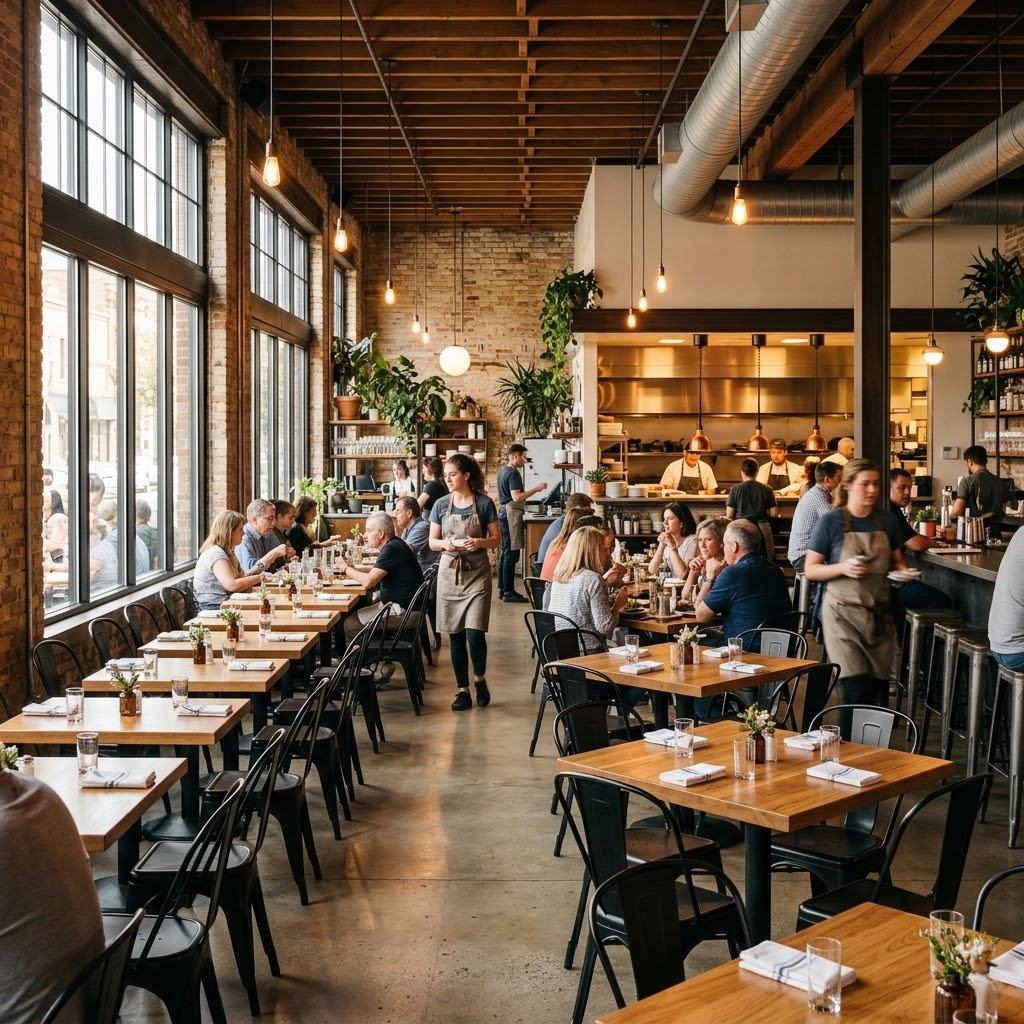
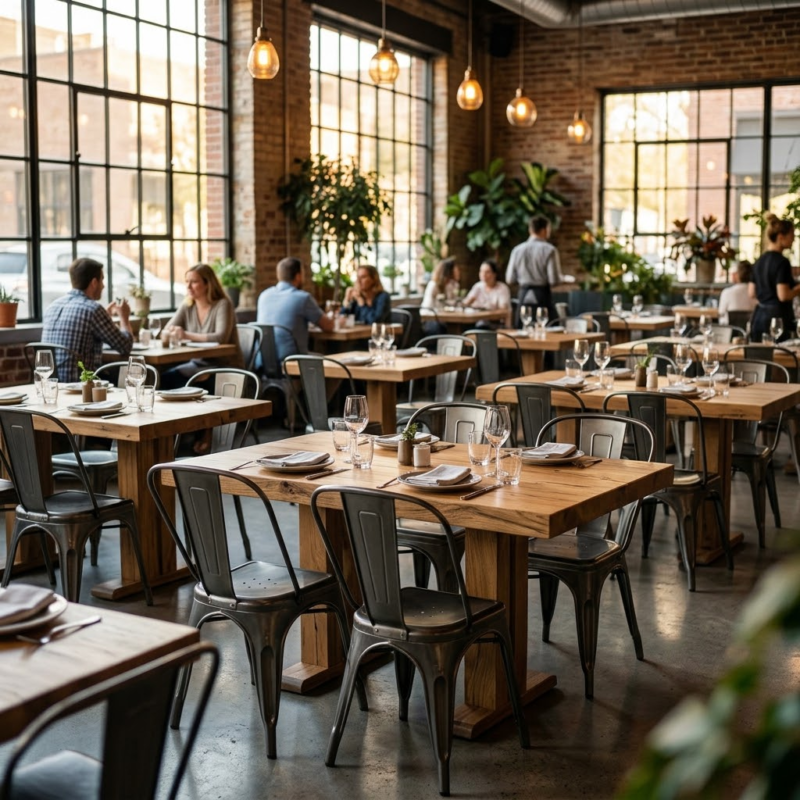
Not all foodservice venues experience the same wear patterns. A quick-service restaurant (QSR) turning tables every 18 minutes requires a vastly different engineering profile than a fine-dining steakhouse where guests linger for three hours over multi-course meals. Before requesting a quotation from a furniture supplier, procurement teams must align their specifications with their venue’s operational archetype.
1.1 Fast-Casual Franchises & Quick-Service Restaurants (QSR)
- Operational Reality: Ultra-high daily seat turnover (8 to 15+ turns per day), frequent tray impacts, aggressive chemical wipe-downs between every party, and price-sensitive multi-unit rollout budgets.
- Recommended Table Spec: 1.25″-thick High-Pressure Laminate (HPL) tabletops bonded to a CARB Phase 2 plywood core with 3mm impact-resistant ABS/PVC edges, mounted on heavy-duty black powder-coated cast-iron X-bases.
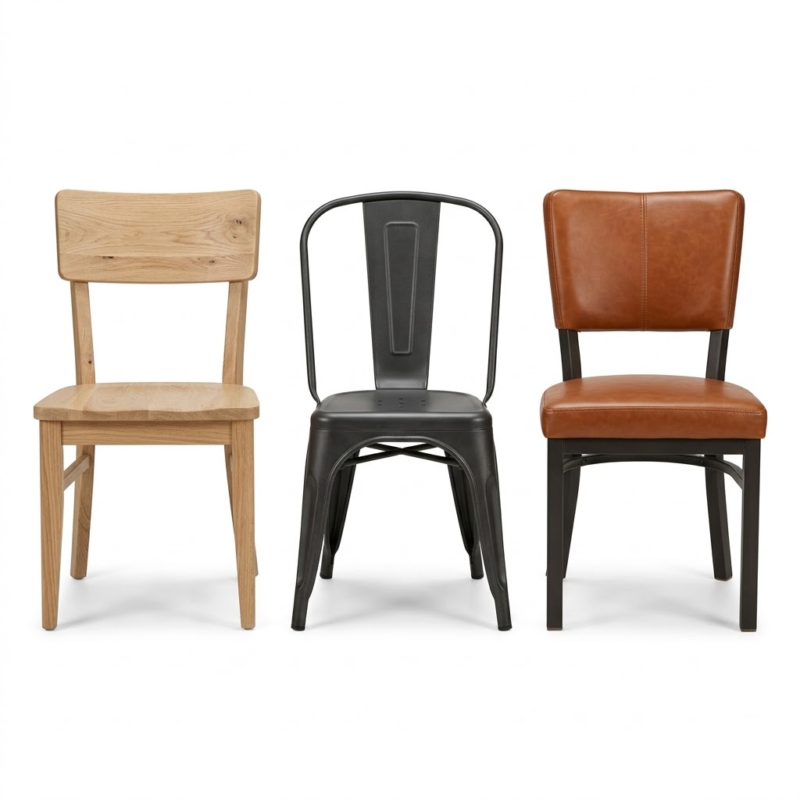
- Recommended Seating Spec: Fully welded 16-gauge steel frame chairs or bentwood/metal hybrid chairs. Avoid porous woven fabrics; specify solid molded plywood seats, powder-coated steel seats, or antimicrobial commercial PU vinyl cushions.
1.2 Specialty Cafes, Bakeries & Coffee Shops
- Operational Reality: High laptop/remote-work dwell times in the morning, tight urban square footage, frequent rearranging of 2-top tables, and heavy indoor-to-sidewalk movement.
- Recommended Table Spec: Compact
24"x24"square or28"–30"round sintered stone or solid butcher-block bistro tables paired with weighted round disc bases that maximize legroom in tight quarters. - Recommended Seating Spec: Lightweight yet structural stackable metal or solid beechwood chairs (stacking 6 to 8 high) for effortless floor mopping at closing time.
1.3 Upscale Casual, Steakhouses & Hotel Dining Rooms
- Operational Reality: Longer guest dwell times (90 to 180 minutes), higher average check sizes, acoustic dampening requirements, and an emphasis on tactile luxury.
- Recommended Table Spec:
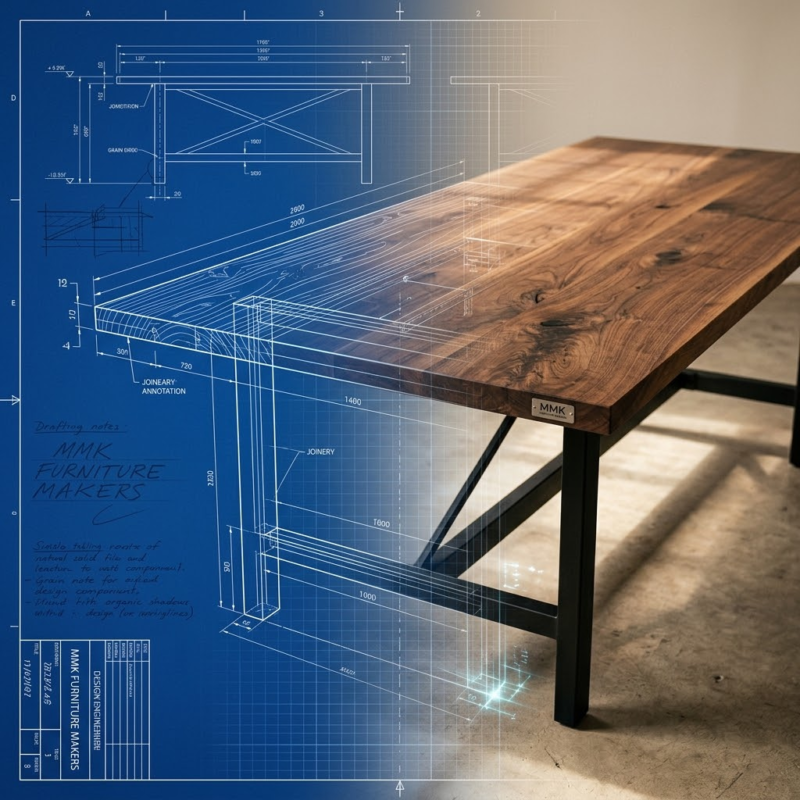
1.5"to2.0"thick kiln-dried solid White Oak or American Black Walnut custom wood dining tables (6%–8% moisture content) with concealed steel anti-warp C-channels and a 5-coat matte 2K polyurethane finish that eliminates the need for costly white table-linenlaundering. - Recommended Seating Spec: Ergonomic solid hardwood armchairs or fully upholstered custom dining chairs utilizing high-resiliency 2.5 lbs/cu.ft CAL 117 foam and performance velvet, crypton-treated woven textiles, or top-grain contract leather rated above 75,000 Wyzenbeek double rubs.
1.4 Banquet Halls, Event Centers & Catering Venues
- Operational Reality: Constant setup, teardown, and high-density back-of-house transport on hand trucks and dollies.
- Recommended Spec: Combine stackable upholstered banquet chairs (featuring protective under-seat stacking bars) with our commercial-grade folding tables & chairs engineered with high-impact blow-molded or HPL tops and gravity-locking steel wishbone legs.
| Hospitality Segment | Avg. Guest Dwell Time | Ideal Tabletop Material | Ideal Chair Construction | Minimum Upholstery Rub Rating | Priority Engineering Feature |
|---|---|---|---|---|---|
| QSR & Fast-Casual | 15 – 35 mins | HPL with 3mm PUR-sealed ABS edge | 16-Gauge welded steel frame + wood/vinyl seat | 100,000+ Double Rubs (or non-upholstered) | Scratch, impact & bleach-sanitizer resistance |
| Cafes & Bistros | 30 – 75 mins | Sintered Stone (12mm) or Butcher Block | Stackable aluminum, steel, or solid beech | 50,000+ Double Rubs (Coated Vinyl) | Compact footprint & stackability (6–8 high) |
| Fine Dining & Hotels | 90 – 180 mins | 1.75″ Solid White Oak / Black Walnut | Mortise-and-tenon hardwood + high-density foam | 75,000+ Double Rubs (Performance Woven/PU) | Acoustic absorption & 3-hour ergonomic comfort |
| Bars & Taprooms | 60 – 120 mins | Distressed Solid Wood or 304 Stainless | 30″ Commercial Barstools with welded footrest | 100,000+ Double Rubs (Bleach-cleanable PU) | Reinforced scuff-plate footrests & liquid proofing |
| Banquets & Events | 120 – 240 mins | Heavy-duty Folding HPL / Plywood | Nesting / Stacking Banquet Chairs (10-high) | 60,000+ Double Rubs (Stain-treated fabric) | High-density dolly storage & frame bumper guards |
Chapter 2: Structural Anatomy of Commercial Tables & Chairs
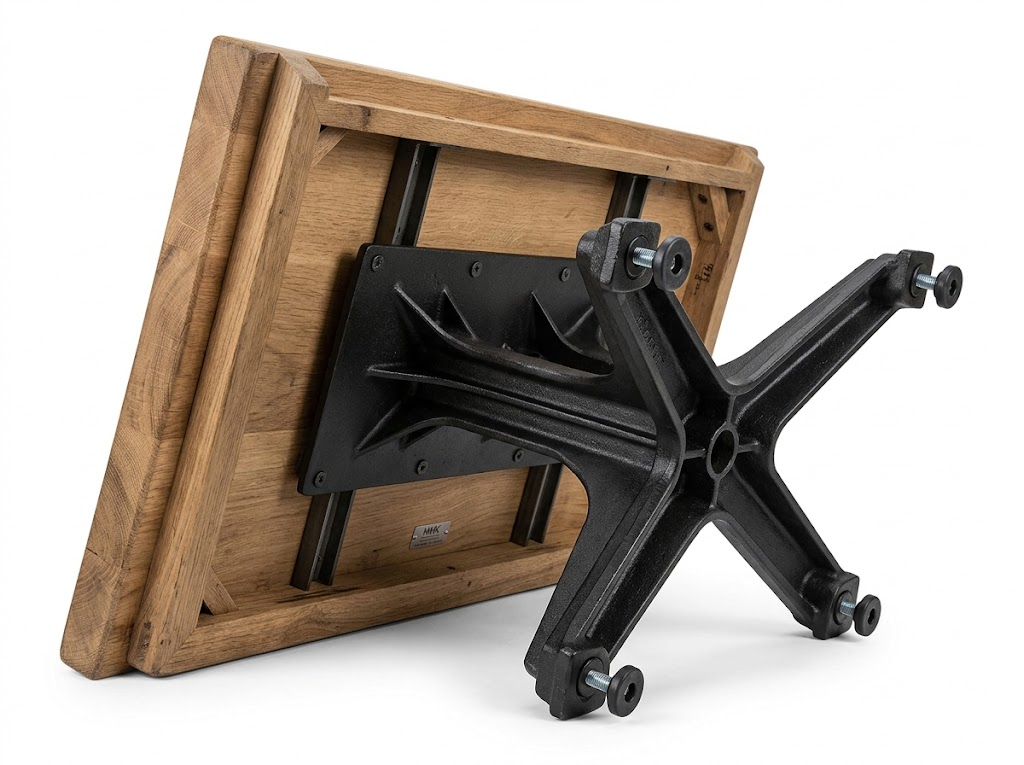
When sourcing commercial dining room tables and wholesale dining chairs, the most expensive failures happen out of sight—beneath the tabletop and inside the chair joints. Here is how MMK TRADE INC engineers contract furniture to survive high-volume restaurant operations.
2.1 The Physics of Table Base Stability: Cast Iron vs. Stamped Steel
A common mistake among first-time restaurant buyers is pairing a heavy solid wood or stone tabletop with a lightweight, thin-gauge stamped sheet-metal base to save $15 per unit. This creates a top-heavy center of gravity that causes the table to sway whenever a guest cuts a steak or leans an elbow on the edge.
- Heavy-Duty Cast Iron Pedestal Bases: For commercial applications, MMK specifies high-density cast-iron base plates (weighing 35 lbs to 85+ lbs depending on spread) paired with 3-inch or 4-inch diameter 14-gauge steel columns and a heavy-duty cast-iron top spider (
12"x12"or15"x15"). - Full-Length Tie-Rod Engineering: Rather than relying on thin welds at the base of the column, our commercial pedestals utilize a solid steel internal tension tie-rod running through the center of the column, mechanically bolting the top spider directly to the heavy cast-iron floor plate.
- Anti-Wobble Leveling Glides: Restaurant floors—especially historic brick, slate tile, or poured concrete—are rarely perfectly flat. Every MMK table base comes equipped with oversized, corrosion-resistant threaded steel-shank nylon leveling glides offering up to 0.75 inches of vertical height adjustment, or optional self-stabilizing hydraulic table glides.
2.2 Table Top-to-Base Span Ratios (Preventing Tipping Liability)
To meet ANSI/BIFMA X5.5 stability criteria, the base footprint must scale proportionally with the tabletop dimensions. When ordering wholesale dining tables as separate tops and bases, always enforce the following pairing rules:
| Tabletop Size & Shape | Required Base Configuration | Recommended Base Footprint Size | Minimum Recommended Column Diameter | ADA Wheelchair Compatible? |
|---|---|---|---|---|
| 24″ x 24″ or 24″ Round | Single X-Base or Round Disc | 22" x 22"Spread /18"Round |
3″ Single Column | No (Too narrow for 30″ width) |
| 30″ x 30″ or 30″ Round | Single X-Base or Round Disc | 22" x 22"or24" x 24"Spread |
3″ Single Column | Conditional (With offset base) |
| 36″ x 36″ or 36″ Round | Single Heavy X-Base | 30" x 30"Spread /24"Round |
4″ Single Column | Yes (Check 27″ knee clearance) |
| 30″ x 48″ Rectangle | Twin T-Bases or Twin Pedestals | 22" x 30"Single or(2x) 5"x22"T-Base |
(2x)3″ Columns |
Yes (At table ends or sides) |
| 30″ x 60″ / 36″ x 60″ Rect. | Twin Heavy T-Bases or 2x X-Bases | (2x) 22" x 22"or(2x) 6"x26"T-Base |
(2x)3″ or 4″ Columns |
Yes |
| 36″ x 72″ Rectangle | Twin X-Bases or 4-Post Trestle | (2x) 22" x 30"Spread |
(2x)4″ Columns |
Yes |
| 48″ Round | Large Cross X-Base or Disc | 33" x 33"or36" x 36"Spread |
4″ Extra-Wide Column | Yes |
2.3 Sanitization-Proof Finishes & Hygiene Engineering
Post-pandemic US health department inspections and guest expectations demand relentless surface sanitization. However, commercial sanitizers—including diluted sodium hypochlorite (bleach), hydrogen peroxide cleaners, quaternary ammonium compounds (“Quats”), and high-proof bar alcohol—rapidly dissolve standard residential furniture lacquers, leaving sticky, cloudy white rings on wood tables and peeling cracking vinyl on chairs.
- Tabletop Chemical Resistance: All MMK wood and veneer tabletops are finished with commercial 2K (Two-Component) Catalyzed Polyurethane or UV-cured acrylic coatings tested against ASTM D1308 chemical spot standards.
- Crumb-Free Seam Design: When upholstery meets the seat frame on our bulk restaurant seating, we eliminate deep button-tufting and exposed welting traps in dining zones, utilizing tight waterfall seat edges and clean-out gaps between the seat cushion and backrest so servers can wipe away food debris in a single swipe.
Chapter 3: Floor-Plan Mathematics & Seating Clearance Checklist
How many tables and chairs do you actually need to order for your commercial space? Over-ordering leaves you with dead inventory in storage; under-ordering or buying oversized chair silhouettes chokes your dining room capacity.
3.1 Calculating Gross vs. Net Dining Area Seat Counts
In US restaurant architecture, typically 60% to 65% of the total leased square footage is allocated to the Front-of-House (FOH) dining and bar area, while 35% to 40% is consumed by the Back-of-House (BOH) kitchen, prep line, dish pit, walk-in coolers, and ADA restrooms.
Once you have your net dining room square footage, use these industry-standard space allowances per seat to calculate your initial wholesale dining chairs and table quantities:
- Fast-Casual / QSR / Counter Service:
11 to 14 sq. ft. per seat - Bistro / Cafe / Pizzeria:
14 to 16 sq. ft. per seat - Full-Service Casual & Family Dining:
15 to 18 sq. ft. per seat - Fine Dining & Upscale Hotel Restaurants:
18 to 22+ sq. ft. per seat
3.2 The “Deuce-Flex” Strategy for Maximum Table Utilization
Restaurant party sizes fluctuate wildly between Tuesday lunch (mostly solo diners and 2-tops) and Friday dinner (4-tops, 6-tops, and large groups). If you fill your floor plan with fixed 6-person round tables, a party of two occupying that table during lunch wastes 66% of your seating capacity.
- The Solution: Experienced hospitality buyers allocate 60% to 70% of their table order to square
30"x30"or rectangular30"x48"straight-edge tables with identical tabletop thickness and leveling glides. - This allows hosts to separated tables for 2-person lunches, and instantly push two
30"x30"tables together to form a seamless30"x60"4-to-6 top for dinner rushes without height mismatches.
Dining Seating Clearance Dimensions Checklist
Before finalizing chair and table widths from our wholesale furniture catalog, verify these critical spatial clearances against your architectural CAD layout:
- Per-Diner Table Edge Width: Allow 24 inches (610 mm) minimum linear table edge per guest (up to 28–30 inches for fine dining with multiple wine glasses and share plates).
- Chair Pull-Out Depth: An occupied dining chair extends 18 to 20 inches from the table edge; a guest standing up or sitting down requires 24 to 30 inches from the table edge.
- Back-to-Back Chair Clearance (No Server Traffic): Minimum 24 inches between the backs of occupied chairs (or 48 inches between parallel table edges).
- Primary Server Service Lane (Between Occupied Chairs): Minimum 30 to 36 inches clear pathway (requiring 60 to 66 inches between parallel table edges).
- ADA Accessible Route & Main Egress Corridor: Strict 36 inches minimum continuous clear width at all times, with 60-inch diameter turning circles at dead-ends and restroom entries.
- Chair Width vs. Table Base Leg Span: If using a 4-leg table rather than a central pedestal, confirm the interior distance between the table legs is at least 4 inches wider than the total width of the two side-by-side dining chairs. (For an in-depth comparison of chair silhouettes, frame weights, and footprint widths, read our upcoming companion guide: *Solid Wood, Metal, or Upholstered? Selecting the Right Commercial Dining Chairs*).
Chapter 4: Whole-Venue FF&E Consolidation (Cutting Freight Costs by 30%+)
When outfitting a new restaurant, cafe, or hotel project, sourcing tables from one vendor, chairs from a second, patio seating from a third, and kitchen prep tables from a fourth destroys your project budget through fragmented LCL (Less-Than-Container-Load) shipping fees, multiple customs brokerage entries, and mismatched wood stain finishes.
Because MMK TRADE INC operates a multi-category manufacturing platform, US hospitality buyers can consolidate their entire Front-of-House and Back-of-House FF&E schedule into a single 40HQ container shipment:
- Front-of-House Dining Core: Combine your primary commercial dining room tables and bulk restaurant seating in unified wood stains and powder-coat RAL colors.
- Waitstaff POS & Bussing Stations: Add matching commercial sideboards and buffets to store menus, flatware, and POS printers. (Learn how service credenzas streamline floor operations in our cluster article: *Why Commercial Sideboards and Buffets Complete Your Dining Fit-Outs*).
- Bar, Taproom & Beverage Zones: Integrate commercial wine & bar cabinets and rolling kitchen island carts for tableside presentation.
- Sidewalk Cafe & Patio Extensions: Maximize seasonal revenue by loading weatherproof outdoor furniture and perimeter garden planters into the remaining cubic volume of your container.
- Back-of-House Culinary & Manager Offices: Complete the container loadout with heavy-gauge stainless steel work tables for the kitchen line and back-office office desks.
Chapter 5: Hospitality B2B Frequently Asked Questions (FAQ)
Q1: How many extra chairs and tables should a restaurant order for a new grand opening (“Attic Stock”)?
A: Industry best practice for US hospitality projects is to order 5% to 8% “Attic Stock” (overage inventory) on your initial container order—particularly for OEM dining chairs or custom-stained tables. Ordering 8 extra chairs on a 120-seat restaurant build-out costs very little when shipped inside your main ocean container, and gives your general manager immediate replacement units on-site if a patron damages a chair or if you need to squeeze extra seating onto the floor for holiday banquets.
Q2: Can MMK Furniture Makers match the exact wood stain and fabric colors from our interior designer’s FF&E specification sheet?
A: Yes. As a custom dining room furniture manufacturer, we regularly work from architectural FF&E schedules. You can send us physical control samples (such as a wood flooring plank, millwork stain chip, or Pantone/RAL color code), and our finishing lab will formulate a custom color match and air-ship physical strike-off blocks to your designer for formal sign-off within 7 to 10 business days.
Q3: Are your commercial dining tables pre-drilled for base installation, or do our contractors drill them on-site?
A: We offer both options depending on your installer’s preference. For standardized orders where you purchase both tabletops and bases from MMK, we CNC-embed threaded brass/steel machine-screw inserts into the underside of the tabletop (or pre-drill pilot holes for self-tapping wood screws), cutting on-site assembly time to less than 3 minutes per table. If you are using custom booth cantilevers or varied base placements on-site, we can leave the underside un-drilled for universal field mounting.
Q4: How do we handle delivery if our restaurant storefront does not have a commercial loading dock?
A: Most urban US restaurants and cafes do not have elevated 48-inch truck docks. When you select our US Door-to-Door DDP shipping service, simply notify your MMK project manager if your site requires Liftgate Delivery or Inside Threshold Delivery. We coordinate final-mile box trucks equipped with hydraulic liftgates and pallet jacks so your shipment can be safely lowered to street level right outside your venue during scheduled non-peak hours.
Conclusion: Build a High-Turnover Dining Room That Lasts
Your dining room furniture is the physical touchpoint that defines every guest’s impression of your brand—from the solid feel of the table edge to the supportive comfort of the chair throughout their meal. By sourcing your bulk restaurant dining tables and wholesale dining chairs directly from MMK Furniture Makers (MMK TRADE INC), you secure commercial-grade structural longevity while saving 30% to 50% compared to domestic middleman distributors.
Outfitting a Restaurant, Cafe, or Hospitality Project?
Send us your floor plan or FF&E schedule for a complimentary seating capacity audit and factory-direct wholesale quotation.
- ✅ Custom Wood Stain & Commercial Vinyl Swatch Matching
- ✅ One-Stop Container Consolidation (Tables, Chairs, Barstools & Patio)
- ✅ Turnkey US DDP Delivery (With Optional Liftgate Service)
👉 **Get Your Custom Hospitality Project Quote & 2026 B2B Price List**Ready to browse models? Explore our Commercial Dining Tables and Wholesale Dining Chairs catalogs now.

One thought on “How to Source Wholesale Dining Tables and Chairs for Restaurants, Cafes, and Hospitality Projects”