
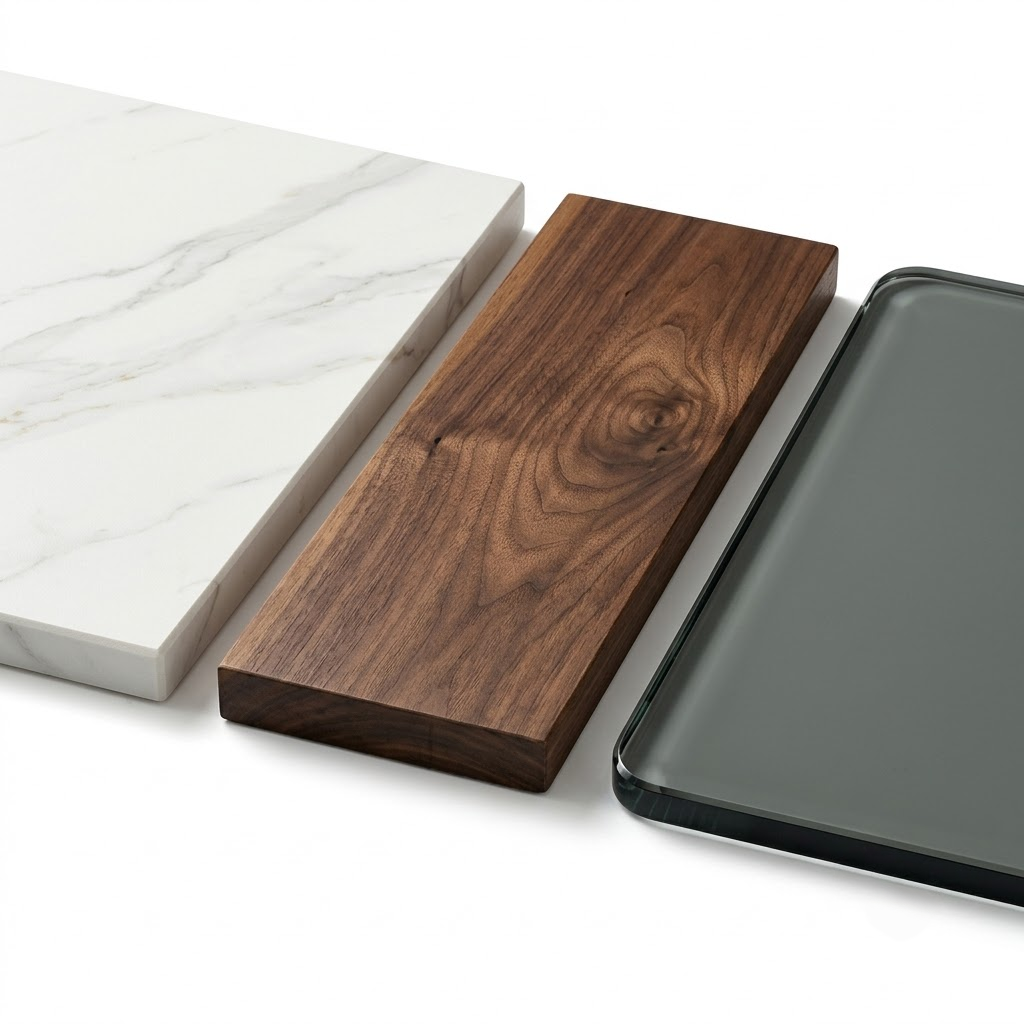
Sintered Stone, Solid Wood, or Tempered Glass? The B2B Guide to Commercial Coffee Table Materials

⚡ Quick Takeaway for Hospitality FF&E & Retail Buyers
- Why Natural Marble Fails in B2B: Quarried marble is soft (Mohs Hardness 3–4), heavy, brittle in transit, and highly porous—absorbing red wine, espresso, and acidic citrus spills within minutes.
- The Sintered Stone Upgrade: Ordering sintered stone center tables bulk delivers luxury stone aesthetics with a Mohs Hardness of 6–7, a <0.05% water absorption rate, and direct heat resistance up to 572°F (300°C)+.
- 2K Polyurethane Wood Protection: To prevent milky white “water rings” on custom coffee tables, MMK TRADE INC seals kiln-dried hardwood (6%–8% EMC) with a 5-stage 2K catalyzed polyurethane coating that resists alcohol, boiling liquids, and housekeeping disinfectants.
- ANSI Z97.1 Tempered Safety Glass: All glass tabletops are thermally tempered to 4x standard strength, permanently laser-etched with 16 CFR Part 1201 / ANSI Z97.1 safety stamps to eliminate commercial liability.
Introduction: Why Tabletop Surfaces Make or Break Commercial ROI
In any hotel lobby, VIP executive lounge, multi-family amenity room, or residential living space, the coffee table endures more concentrated surface abuse than almost any other piece of furniture. Unlike a media console that sits untouched against a wall, a center table is a high-contact horizontal workhorse: it is subjected to scalding ceramic coffee mugs, sweating cocktail glasses, metal laptop chassis, keys, hard-shell luggage corners, and aggressive daily wiping by housekeeping crews.
When B2B procurement managers source wholesale coffee tables using residential material specifications, three costly failures inevitably occur within the first 12 months:
- Natural Marble Etching & Breakage: Quarried Carrara or Calacatta marble slabs crack along natural fissures during LTL transit and suffer permanent acid etching the moment a guest spills wine, soda, or lemon water.
- Wood “Water Rings” & Veneer Delamination: Standard 1-component (1K) nitrocellulose lacquer softens under heat and moisture, trapping condensation beneath the clear coat and leaving unsightly milky-white rings.
- Glass Shatter Liability: Untempered or thin annealed glass tops chip along 90-degree edges and pose severe laceration liabilities in commercial public spaces.
As a vertically integrated commercial coffee table manufacturer, MMK Furniture Makers (operated by MMK TRADE INC) solves these operational headaches through industrial material science. This engineering guide compares the exact hardness, porosity, and thermal specifications of the four primary tabletop surfaces to help you specify high-margin, zero-claim custom coffee tables.
1. The 4-Material Engineering Matrix: Hardness, Porosity & Thermal Specs
To assist hospitality FF&E specifiers, interior designers, and retail merchandising directors in making data-driven procurement decisions, our materials laboratory compiled the side-by-side performance benchmarks of the four dominant center table surfaces:
| Engineering Metric | Sintered Stone (MMK Recommended) | Natural Quarried Marble | 2K PU-Sealed Solid Wood / Veneer | ANSI Z97.1 Tempered Glass |
|---|---|---|---|---|
| Mohs Scratch Hardness | 6.0 – 7.0 (Resists steel blades & keys) | 3.0 – 4.0 (Scratches easily) | 2.5 – 3.5 (Janka 1,010–1,360 lbf + 2H Coat) | 5.5 – 6.0 (Resists everyday abrasion) |
| Water Absorption (Porosity) | < 0.05% (100% Non-porous; zero sealing) | 0.5% – 2.0% (High stain & acid etching risk) | 0% Surface Penetration (With 5-Coat 2K PU) | 0.00% (Completely impervious) |
| Thermal Shock Resistance | Up to 572°F+ (300°C+ Direct heat safe) | 300°F (150°C; prone to thermal micro-cracks) | Up to 212°F (100°C; no white heat rings) | Up to 470°F (240°C Tempered rating) |
| Transit Breakage Rate (ISTA 3A) | < 0.3% (With plywood/honeycomb backing) | 8% – 15% (Fissures snap in parcel transit) | < 0.2% (Highest drop-test resilience) | < 0.8% (Requires EPE suspension crating) |
| Unit Weight & Freight Impact | Medium (12mm slab = 40% lighter than marble) | Extreme (20mm–30mm slab adds LTL surcharges) | Low-Medium (Optimal for FedEx/UPS parcel) | Medium (8mm–12mm tempered plate) |
| Ideal Commercial Application | Luxury hotel lobbies, VIP lounges, high-end retail | Low-traffic decorative residential only | Hotel guestrooms, executive offices, e-commerce | Modern corporate waiting rooms, compact suites |
2. Sintered Stone vs. Natural Marble: The Ultimate Commercial Replacement
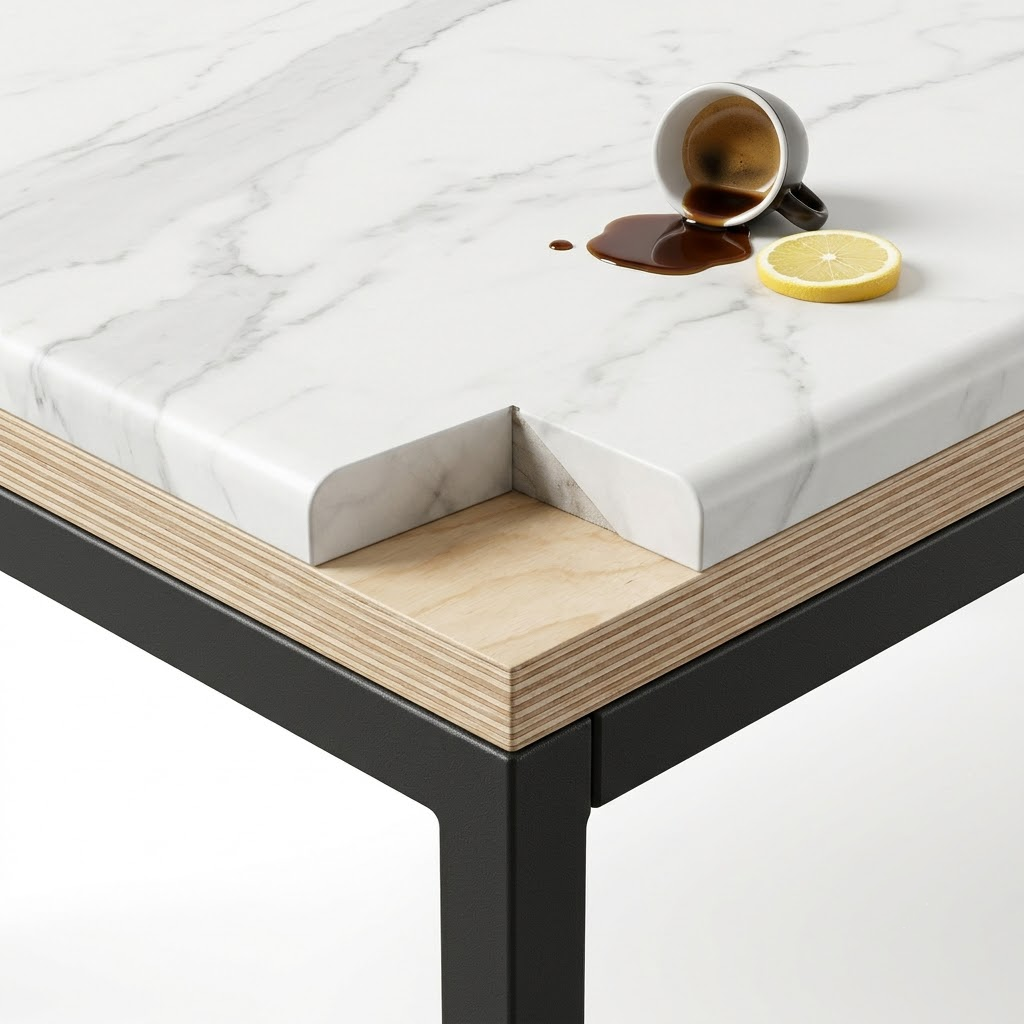
For decades, interior designers specified natural Italian Carrara, Calacatta, or Nero Marquina marble to signal luxury. However, for B2B furniture distributors and hotel operators, natural marble is a supply chain nightmare. Because marble is a calcium carbonate sedimentary rock, it reacts chemically with mild acids (coffee, wine, orange juice), leaving permanent dull spots known as “etching.” Furthermore, natural stone veins are structural fault lines; during US final-mile parcel delivery, up to 15% of unbacked marble coffee tables arrive cracked in half.
2.1 How Sintered Stone Is Engineered
To eliminate these liabilities while preserving the dramatic veining of luxury stone, procurement teams now specify sintered stone center tables bulk orders. Sintered stone is manufactured by taking 100% natural mineral powders (quartz, feldspar, silica, and natural oxides), compacting them under 15,000+ tons of hydraulic pressure, and firing the slab in a kiln at over 2,192°F (1,200°C).
- Zero Porosity (<0.05% Absorption): Unlike marble, which requires periodic chemical sealing, sintered stone is vitrified at the molecular level. Red wine, permanent marker, and boiling espresso sit on the surface and wipe away with water or bleach-based cleaners.
- Mohs Hardness 6 to 7: Surpassing stainless steel (Mohs 5.5), sintered stone cannot be scratched by metal laptop corners, keys, or tableware.
- 100% Batch Consistency for Large Projects: When outfitting a 300-room hotel, natural marble slabs vary wildly in color and vein density. Sintered stone utilizes high-definition mineral glazing, guaranteeing that unit #1 and unit #300 match your approved sample swatch identically.
2.2 MMK’s Composite Sub-Frame Lamination (Preventing Edge Chipping)
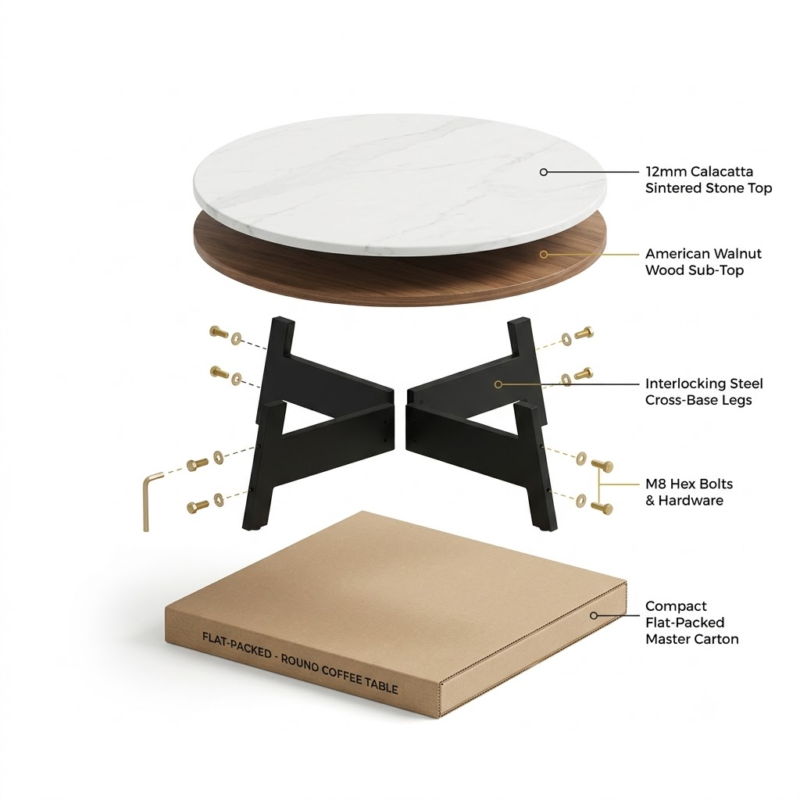
While sintered stone is extraordinarily hard, a raw 6mm or 12mm stone slab suspended directly over hollow metal legs can still chip if struck on its outer edge by a heavy object. As an engineering-led commercial coffee table manufacturer, MMK TRADE INC laminates every large sintered stone top onto a 15mm–18mm CNC-chamfered E0 Birch plywood or aluminum honeycomb backer core using high-elasticity polyurethane structural adhesive. This composite layer dampens vibration, absorbs heavy point-load impacts, and provides a solid wood anchor for threading heavy-duty metal base bolts.
3. Solid Hardwood & Veneer: Eliminating “Water Rings” with 2K Polyurethane
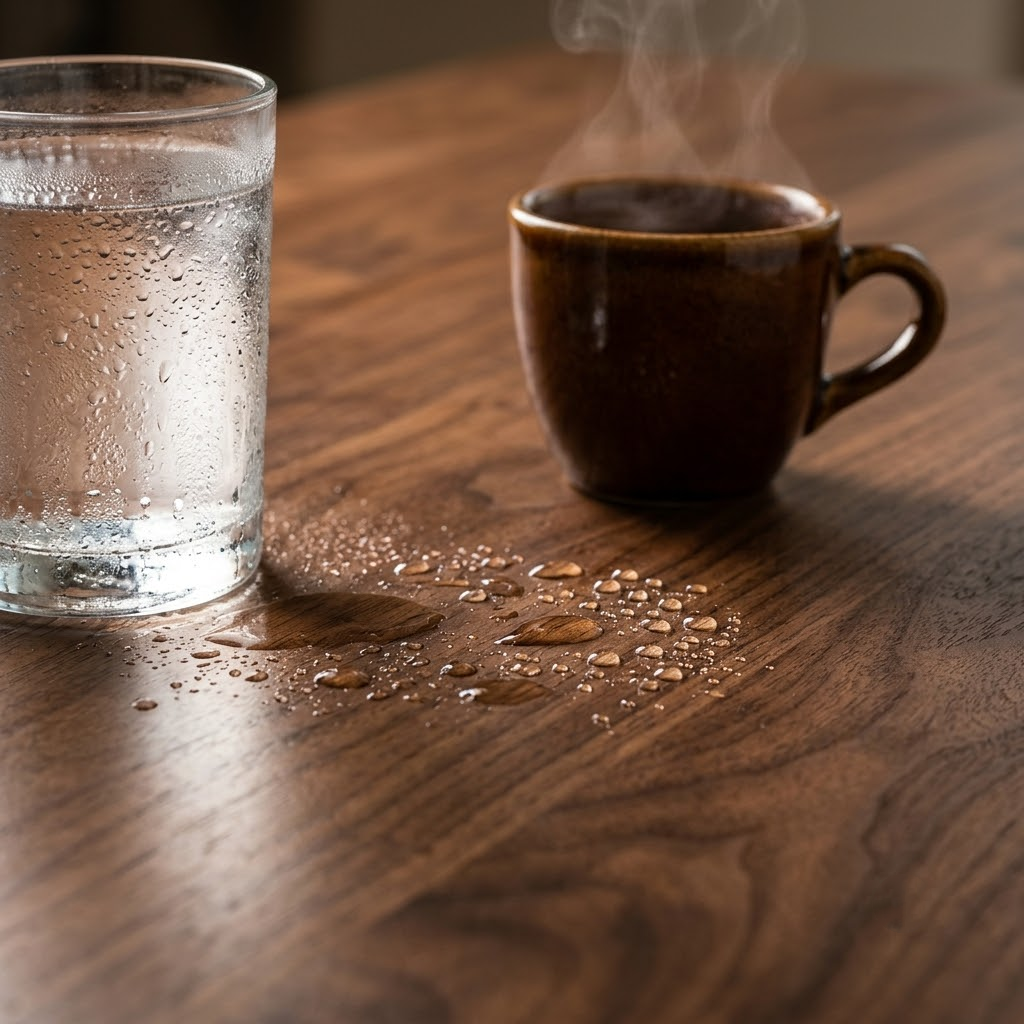
For warm mid-century modern, organic contemporary, and executive lounge interiors, nothing replaces the tactile richness of real wood. However, wood is hygroscopic. If a factory cuts corners on lumber drying or surface chemistry, a wood center table will quickly become an eyesore of white heat rings, swollen seams, and delaminated edges.
3.1 The Science of the 5-Coat 2K Catalyzed Polyurethane Finish
Why do residential wood coffee tables develop white rings when a cold drink or hot mug is placed on them without a coaster? Budget factories spray cheap 1-Component (1K) Nitrocellulose (NC) Lacquer. NC lacquer dries purely by solvent evaporation; when exposed to heat (above 120°F) or prolonged condensation, the microscopic pores reopen, trapping moisture vapor inside the clear coat.
When manufacturing custom coffee tables for the US market, MMK TRADE INC utilizes an automotive-grade 2-Component (2K) Catalyzed Polyurethane (PU) Finishing System:
- Cross-Linked Polymer Shield: By mixing a polymeric resin base with an isocyanate hardener (catalyst) immediately prior to robotic spraying, the finish cures via an irreversible chemical cross-linking reaction.
- 2H Pencil Hardness & Heat Immunity: Once cured through our 5-stage sanding and baking line, the 2K PU film achieves a 2H surface hardness rating and withstands direct contact with boiling cups (212°F / 100°C), 80-proof alcohol spills, and commercial quaternary ammonium disinfectants without clouding, blistering, or leaving water rings.
3.2 Kiln-Dried Solid Hardwood vs. Architectural Veneer over TSCA Title VI Cores
Depending on your target retail price point and design geometry, we engineer wood coffee tables in two commercial configurations:
- 100% Solid Kiln-Dried Hardwood (FAS Grade): Ideal for organic live-edge, fluted, or heavy rustic designs. All American Black Walnut, White Oak, and Ash lumber is kiln-dried to a strict 6%–8% Equilibrium Moisture Content (EMC) to prevent splitting in dry US winter climates.
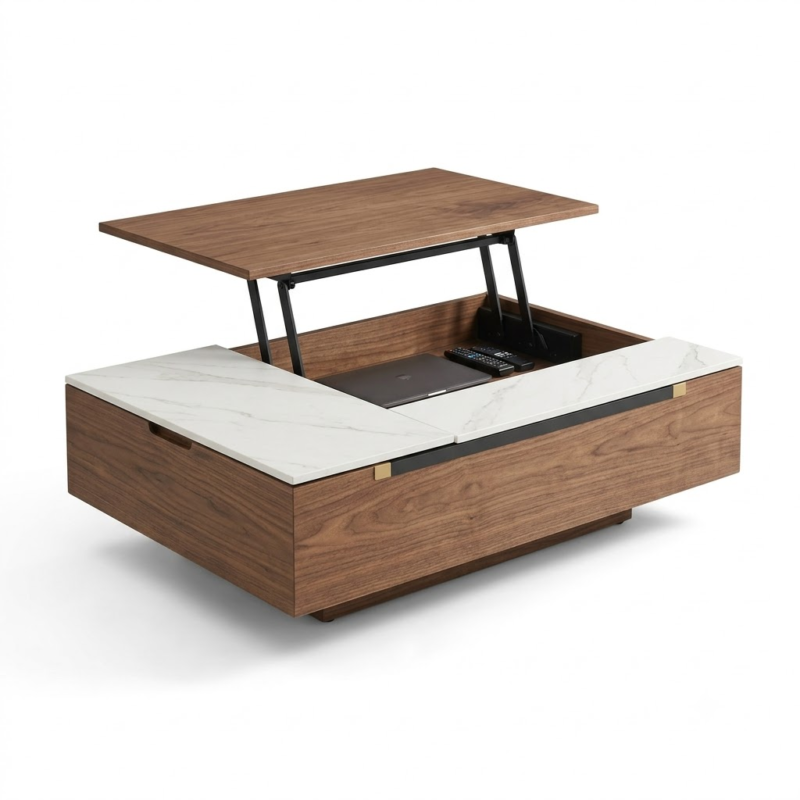
- 0.6mm Thick-Cut Hardwood Veneer over E0 MDF/Plywood: For wide, drum-style coffee tables, curved waterfall profiles, or lift-top storage tables where solid wood movement would jam mechanical hardware, we press 0.6mm architectural wood veneer over CARB Phase 2 / TSCA Title VI certified substrates, sealed with heat-proof PUR edge-banding.
4. Tempered Safety Glass: ANSI Z97.1 Compliance & Edge Engineering
Glass-topped center tables—especially smoked bronze, grey-tinted, or fluted reeded glass paired with brushed brass or matte black steel frames—are perennial bestsellers because they showcase architectural rugs and make compact hotel guestrooms or urban apartments feel spacious.
4.1 Mandatory US Safety Glazing Standards (16 CFR Part 1201 & ANSI Z97.1)
In commercial hospitality and multi-family common areas, glass is a high-scrutiny liability item. Standard annealed float glass breaks into lethal, dagger-like shards under impact. At MMK TRADE INC, 100% of our glass coffee table tops are manufactured using 8mm, 10mm, or 12mm Thermally Tempered Safety Glass:
- 400% Impact Strength: Heated to 1,150°F (620°C) and rapidly air-quenched, tempered glass places the outer surfaces into high compression, delivering 4 to 5 times the mechanical impact strength of standard glass.
- Safe Dicing Pattern: If broken by an extreme force, the internal tension causes the entire sheet to crumble instantly into harmless, pebble-sized interlocking cubes free of sharp points, fully complying with ANSI Z97.1 and CPSC 16 CFR Part 1201.
- CNC Flat-Polished & Pencil-Radius Edges: Glass panels are weakest along their perimeter. Prior to tempering, our CNC glass-edging machines grind a smooth C-shape (pencil polish) or flat-beveled radius around the entire perimeter, eliminating sharp 90-degree corners that chip when struck by cocktail glasses.
- UV-Bonded Stainless Steel Pucks vs. Suction Cups: Cheap glass tables rest on clear rubber suction cups that turn yellow and lose grip. For commercial installations, MMK uses industrial UV-cured shadowless adhesive to bond solid stainless steel mounting pucks directly to the underside of the tempered glass, mechanically bolting the top to the metal or wood base so it can never slide off.
5. Synchronizing Coffee Tables with Side & End Tables
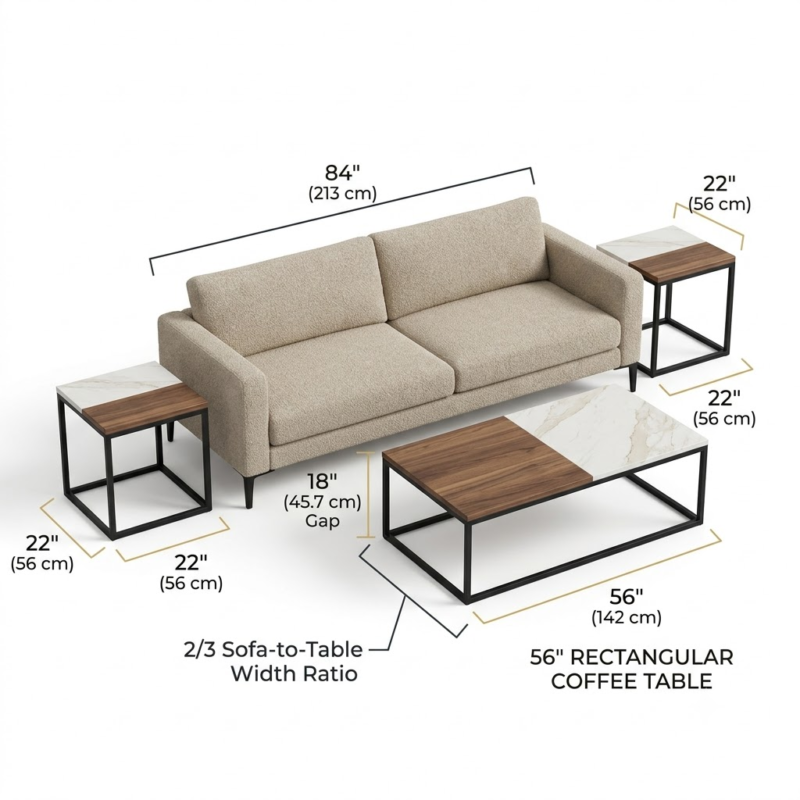
In both B2B hospitality procurement and retail e-commerce merchandising, a coffee table rarely sells alone. Buyers expect to source coordinated occasional table groups (often sold as a “3-Piece Occasional Table Pack” consisting of 1 center coffee table and 2 matching flanking end tables).
If you source your sintered stone or walnut wholesale coffee tables from one vendor and your wholesale side and end tables from another, the stone veining patterns, wood stain undertones, and metal powder-coat sheens will clash visibly when placed side-by-side in a room.
By consolidating your occasional table program with MMK TRADE INC, our production line cuts the tops for both your 48-inch center coffee tables and your 22-inch accent end tables from the exact same sintered stone master slab or hardwood veneer flitch, and runs them through the same 2K finishing line—extending that exact material harmony across your TV stands and commercial sofas.
6. B2B Coffee Table Material FAQ
Q1: Does sintered stone look artificial compared to natural marble?
Q2: How do you package sintered stone and tempered glass coffee tables to survive FedEx/UPS parcel shipping?
Q3: Can we mix different tabletop materials (e.g., sintered stone top with solid walnut base) in an OEM design?
Q4: What is the Minimum Order Quantity (MOQ) for bulk sintered stone or solid wood center tables?
Request Physical Surface Swatches for Your Next Project
Test our Mohs-7 sintered stone slabs, 2K-sealed hardwood panels, and powder-coated metal finishes in your own studio. Partner with MMK TRADE INC for factory-direct OEM coffee table manufacturing.
✅ ISTA 3A Drop-Tested Packaging
✅ Turnkey US Door-to-Door DDP Delivery
Order Material Swatches & Get 2026 Wholesale Price List →






One thought on “Sintered Stone, Solid Wood, or Tempered Glass? The B2B Guide to Commercial Coffee Table Materials”